About 40 years ago, astronomers saw
a long ribbon of gas stretching almost halfway across the Milky Way Galaxy.
This ribbon of gas was named the Magellanic Stream after what astronomers
thought it came from: the Small or Large Magellanic Cloud. Until now, astronomers
were uncertain from which cloud the ribbon came from. But now they know for
certain that it came from the Small Magellanic Cloud about 2 million years
ago.
This was reported in
The Astrophysical Journal. They found
this out by studying the composition of the Magellanic Stream. Most of the
strips components matched those of the Small Magellanic Cloud. But, parts of
the Stream closer to the Clouds found a higher abundance of sulfur, which
matches with the Large Magellanic Cloud. This suggests that this strip was
ripped off of the Large Magellanic Cloud more recently. Spacetelescope.org
gives us more insight on the topic.
The Magellanic Clouds, are two
dwarf galaxies that orbit our galaxy. While it was unknown from where the
Stream came from, computer mode
ls of the Stream predicted it solely cam from
the Small Magellanic Cloud because of its weaker gravitational pull compared to
the large Magellanic Cloud. In order to find out the abundance of elements in
the stream, they had to look through the ultraviolet part of the
electromagnetic spectrum. Only the Hubble telescope is capable of doing this.
Source:
Astronomy
Posted by Unknown
|
at
9:03 AM
|
_by_TRAPPIST_on_2013-11-15.jpg) |
| Comet ISON 15 November 2013 |
Comet
ISON was bathed with solar radiation in December, which caused the ice on the
comet to turn into gas. Because of the close proximity to the sun, the nucleus
of the comet was expected to spew a lot of gas and releas rocks and dust with
it. The sunlight would then reflect against these particles giving the
particles a yellowish color. The comet is about 3 miles in diameter. The
material that was released because of the radiation forms a spherical halo,
known as a coma. This would create a really long tale. There are many different
predictions as to how bright the comet will be. It was predicted that on
December 1, comet ISON would be as bright as Mars and by late December it would
be visible for observers as long as the sky is dark.
 |
| Comet ISON 8 October 2013 |
According to a CNN article, as of
right now, the fate of comet ISON is unknown. Most scientists believe that 90%
of ISON was destroyed because of the close proximity to the Sun. The Hubble
Telescope will determine what remains of ISON. Even though it wasn’t the comet
that scientists were expecting, it did provide lots of information. As of right now, it is called a comet remnant.
Source:
Astronomy
December 2013
Posted by Unknown
|
at
10:45 AM
|

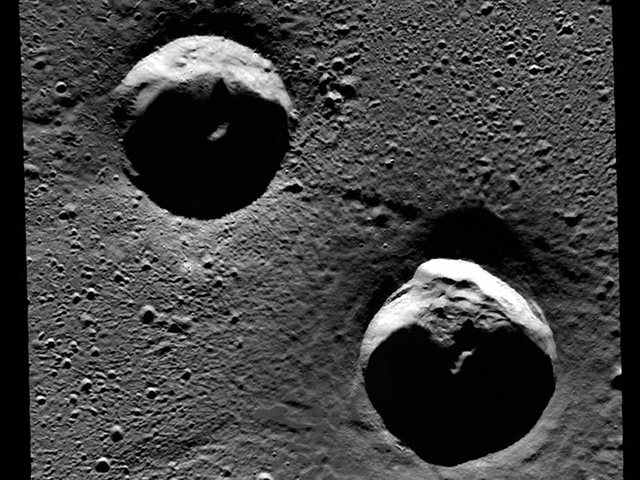
On November 29, 2012, the
Huffington Post reports that NASA’s Messenger probe has discovered water ice at
the poles of Mercury. These areas of water ice are at impact craters where the
ice never sees the sun. These craters are in shadow regions. Messenger used a
neuron spectroscopy that measures the levels of Hydrogen concentration in order
to find out if there was any water present. Messenger was launched in 2004; it
made three flybys of Mercury between 2008 and 2009 until it entered into
Mercury’s orbit in 2011.

In the article
Torrid Mercury’s icy poles from Astronomy, it says that scientist
for decades have believed that their might be water ice in the corners of the
innermost planets of our sola system. “During the past several decades,
scientists have come to realize that a conspiracy of freak accidents involving
Mercury’s motion and orientation had created small regions on the planet’s
surface where it ought to be cold enough for ice to form and survive for
billions of years”. 40 years ago, however, NASA’s Mariner 10 was not able to
make the same observations that Messenger was able to make. Radar observations
on Earth detected “unusually reflective regions in Mercury’s polar regions”.
Mercury is most likely tidally locked with the Sun and always has the same face
that points towards the Sun.
Sources:
Posted by Unknown
|
at
1:49 PM
|